Saturday, September 28, 2013

Cavatina

"Cavatina" is a classical guitar piece by Stanley Myers and the theme from The Deer Hunter.
The piece had been recorded by classical guitarist John Williams, long before the film that made it famous. It had originally been written for piano but at Williams' invitation, Myers re-wrote it for guitar and expanded it. After this transformation, it was first used for the film, The Walking Stick (1970). In 1973, Cleo Laine wrote lyrics and recorded the song as "He Was Beautiful", accompanied by John Williams himself.
Following the release of The Deer Hunter in 1978, Williams' instrumental version of "Cavatina" became a UK Top 20 hit. Two other versions also made the Top 20 the same year - another instrumental recording by The Shadows, with an electric guitar played by Hank Marvin, released on their album String of Hits with the name "Theme from The Deer Hunter" (number 9 in the UK singles charts and number 1 in The Netherlands); and a vocal version (using Cleo Laine's lyrics) by Iris Williams.
The song was also recorded by Paul Potts on his debut album, One Chance.
There is a gospel version set to Cavatina called "Beautiful"; the author is Billy Evmur and it appears in the Dove On A Distant Oak Tree collection. Another vocal version with different lyrics was recorded by Vince Hill (released on the compilation The Ember Records Story Vol. 2 - 1960-1979).
In 2009, the song formed the tenth track of Camilla Kerslake's début album Camilla Kerslake.
In 2011, the song was recorded by singer Joe McElderry and guitarist Milos Karadaglic for McElderry's second album, Classic.


Saturday, September 14, 2013

My Favourite Things

"My Favorite Things" is a popular Christmas song, It was originally from the 1959 Rodgers and Hammerstein musical The Sound of Music.


Saturday, September 7, 2013

Blue Bossa

"Blue Bossa" is an instrumental jazz composition by Kenny Dorham. It was introduced on Joe Henderson's 1963 album Page One. A blend of hard bop and bossa nova, the tune was possibly influenced by Dorham's visit to the Rio de Janeiro Jazz Festival in 1961. The tune has since been recorded numerous times by different artists, making it a jazz standard.


Saturday, August 31, 2013

Ame des Poetes

Song from Charles Trenet


Wednesday, August 21, 2013

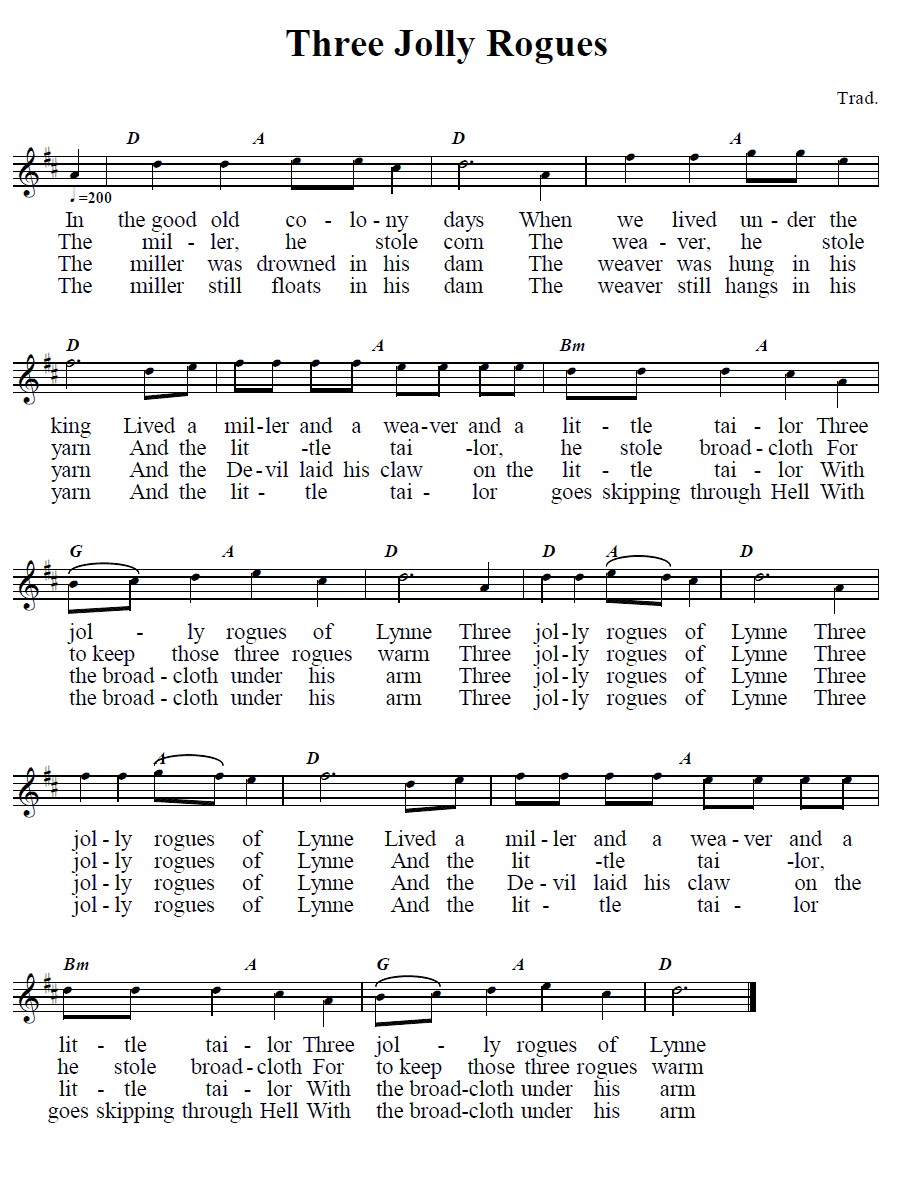
Three Jolie Rogues

Three Jolly Rogues is an English folk song.

A miller, a weaver and a tailor lived in King Arthur's time (or in "Good Old Colonial times"). They were thrown out because they could not sing. All three were thieves. They are suitably punished.
The Miller got drowned in a dam
The Weaver got hung in his yarn
The Tailor tripped as he ran away with the broadcloth under his arm

Wednesday, August 14, 2013

Petite fleur

Well-known song from Sidney Bechet


Saturday, July 6, 2013

Drunk Scotsman

Funny song about a drunk Scotsman


Saturday, June 22, 2013

Galway Girl

A song by Steve Earle and the fantastic Sharon Shannon

Sunday, June 16, 2013

100.000 visitors!

I've just welcomed my 100.000th visitor!
I thank you all for the support over the last 3 years.

Greetings,
Filip

Cowboy waltz


Tuesday, June 11, 2013

Heart and Soul

"Hoagy" Carmichael (born Howard Hoagland Carmichael; November 22, 1899 – December 27, 1981) was an American composer, pianist, singer, actor, and bandleader. He is best known for composing the music for "Stardust", "Georgia on My Mind", "The Nearness of You", and "Heart and Soul", four of the most-recorded American songs of all time.


Wednesday, June 5, 2013

Chega De Saudade

"Chega De Saudade" (published English version is "No More Blues") is often considered to be the first recorded bossa nova song. The music was composed by Antonio Carlos Jobim


Tuesday, May 28, 2013

Desafinado

Antônio Carlos Brasileiro de Almeida Jobim (January 25, 1927 – December 8, 1994), also known as Tom Jobim (Portuguese pronunciation: [ˈtõ ʒoˈbĩ]), was a Brazilian songwriter, composer, arranger, singer, and pianist/guitarist. He was a primary force behind the creation of the bossa nova style, and his songs have been performed by many singers and instrumentalists within Brazil and internationally.
Widely known as the composer of "Garota de Ipanema" (The Girl from Ipanema), one of the most recorded songs of all time, Jobim has left a large number of songs that are today included in the standard Jazz and Pop repertoires.
"Desafinado", a Portuguese word (usually rendered into English as "Out of Tune", or as "Off Key"), is the title of a bossa nova song composed by Antonio Carlos Jobim.


Saturday, May 18, 2013

Black Orpheus

Jazz standard from Luis Bonfa


Tuesday, May 7, 2013

All of me

"All of Me" is a popular song and jazz standard written by Gerald Marks and Seymour Simons in 1931.


Tuesday, April 30, 2013

Moon river

"Moon River" is a song composed by Henry Mancini with lyrics written by Johnny Mercer. It received an Academy Award for Best Original Song for its first performance by Audrey Hepburn in the 1961 movie Breakfast at Tiffany's. It also won Mancini the 1962 Grammy Award for Record of the Year and Mercer the Grammy Award for Song of the Year. Since its original performance, the song has been covered by many other artists.
It became the theme song for Andy Williams, who first recorded it in 1961 and performed it at the Academy Awards ceremonies in 1962. He sang the first eight bars at the beginning of his television show and also named his production company and venue in Branson, Missouri, after it. Williams's version was disliked by Cadence Records president Archie Bleyer, who believed it had little or no appeal to teenagers.[citation needed] Andy Williams's version never charted, except as an LP track, which he recorded for Columbia in a hit album of 1962.
The success of the song was responsible for relaunching Mercer's career as a songwriter, which had stalled in the mid-1950s because rock and roll replaced jazz standards as the popular music of the time. An inlet near Savannah, Georgia, Johnny Mercer's hometown, was named Moon River in honor of him and this song. The popularity of the song is such that it has been used as a test sample in a study on people's memories of popular songs.


Tuesday, April 23, 2013

Nuages

"Nuages" (French pronunciation: ​[nɥaʒ]) is one of the best-known compositions by Django Reinhardt. He recorded about thirteen versions of the song, which is a jazz standard and a mainstay of the gypsy swing repertoire. English and French lyrics have been added to the originally instrumental piece. The title translates in English as "Clouds"; though the English lyric adaptation is titled "It's the bluest kind of blues".


Saturday, April 13, 2013

Bluesette

Jean-Baptiste Frédéric Isidor, Baron Thielemans (born 29 April 1922, Brussels, Belgium), known as Toots Thielemans, is a Belgian jazz musician well known for his guitar and harmonica playing as well as his whistling. Thielemans is credited as one of the greatest harmonica players of the 20th century.

 A jazz standard by Toots Thielemans is "Bluesette" where he used whistling and guitar in unison. First recorded by Toots in 1962, with lyrics added by Norman Gimbel the song became a major worldwide hit.


Monday, April 8, 2013

Love Theme from "The Godfather"

"Speak Softly Love (Love Theme from The Godfather)" is a song written for The Godfather (1972), the first film in the Godfather trilogy. While its instrumental version is simply known as "The Godfather Love Theme", "Speak Softly Love" is the vocal version. The words are by Larry Kusik but the music itself is by Nino Rota. The signature musical theme that opens the piece closely models a theme that appears early in "Preludio - Povero Ernesto!" in the opera Don Pasquale by Gaetano Donizetti (1797-1848). A similar melody also appears in the Overture to "La Forza del Destino" by Giuseppe Verdi (1813-1901). There are also different sets of lyrics for the song in Italian ("Parla Più Piano") and also in Sicilian ("Brucia La Terra"). The Sicilian version is sung by Anthony Corleone (Franc D'Ambrosio) in The Godfather Part III.
Rota had used a more comedic version of the song for the 1958 film Fortunella. When this was discovered, Rota's score for The Godfather was disqualified from consideration at the 1973 Academy Awards; it had been nominated for Best Original Score. However, Rota's score for The Godfather Part II won the 1974 Academy Award for Best Original Score, despite containing the same piece.


Tuesday, April 2, 2013

Mna ha h-eireann (Women of Ireland)

"Mná na hÉireann" (English: Women of Ireland), is a poem written by Ulster poet Peadar Ó Doirnín (1704–1796), popularly set in song to the tune by Seán Ó Riada (1931–1971). Mná na hÉireann is usually placed in the category of Irish rebel music. It honours the memory of the women dedicated to Ireland, specifically the Irish nationalist movement.